
For many students at Northwestern University in Qatar (NU-Q), their week includes more than camera field days, hosting interviews, or writing essays. Besides these essentials, they spend a considerable time conjugating verbs or practicing a whole new alphabet in various language classes.
Even though NU-Q doesn’t offer foreign-language courses as part of its degree programs, nor require them for graduation, many Wildcats still take the initiative to learn French, Arabic, or Spanish by cross-registering at other Education City (EC) universities.
The process, supported by NU-Q’s Academic Advising office, is fairly straightforward. Yet, for those who take the leap, it’s not just a matter of filling out forms or organizing suitable schedules. It’s a test of commitment, time management, and adaptability that rewards in whether global reporting, graduate school abroad, or simply a wider world than they knew when they arrived at NU-Q. So why do they do it?
Arabic at Georgetown University in Qatar (GU-Q): A Daily Commitment
For journalism junior Lale Göncüoğlu, what started as a whimsical fascination with Arabic turned into a serious academic commitment. Her Arabic class at GU-Q meets five times a week, with hours of homework and practice in between. She spends two to three hours every day reviewing vocabulary, writing, and preparing for class.
“Georgetown is intense. In Georgetown, you have to make double efforts,” she said, highlighting that she spends “a minimum of 20 hours a week.” According to Göncüoğlu, the syllabus for her Arabic courses is the same as the one offered at Georgetown University’s Washington, D.C., campus.
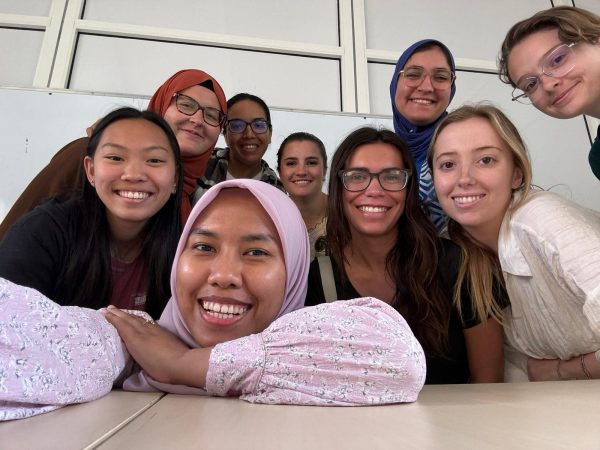
Studying at GU-Q means adjusting not just to a new language but to a new academic culture. The teaching style, grading standards, and workload differ from what most NU-Q students are accustomed to. Still, for Göncüoğlu, that intensity has brought her closer to her career goals: to work with Arabic-speaking immigrant communities. She believes that mastering the language will open doors for her as she seeks to combine her journalism background with opportunities in the legal field in the future.
Learning Efficiency Through Structure
While Göncüoğlu emphasizes intensity, communication junior Timaa Kamar, sees the structure of her Spanish course at Carnegie Mellon University in Qatar (CMU-Q) in terms of efficiency. Having previously studied other languages through tutoring and self-study, she noticed how much faster she progressed in a college setting.
“The biggest difference between learning Spanish at college and learning it outside, in your own time or with your tutor, is that, in college, you get exams and it’s more fast-paced,” she said. “You learn a lot through assignments, through exams, through quizzes. It might be difficult in the moment, but you don’t realize how much you are learning until you reach a place where you can speak and write it.”
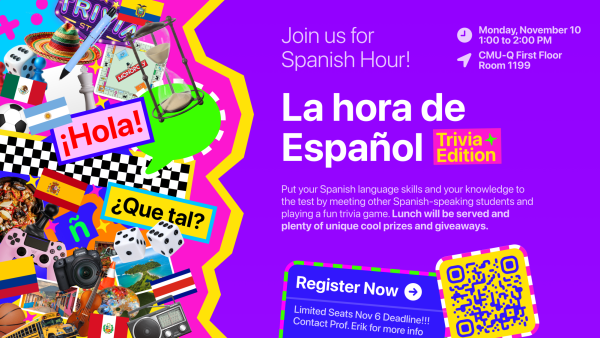
The constant testing and practice, she explained, made learning for her more efficient. Unlike self-paced study, college courses keep her on track with clear milestones. The process can feel demanding, but it delivers visible results.
Despite not being counted in her NU-Q transcript, Spanish is an investment in her future. “You never know where life will take you,” she said. “You might end up in a Spanish-speaking country or apply for a job where it becomes really useful.”
Learning Outside of the Classroom
Students who take language courses across EC learn that progress doesn’t come from the hours spent in the classroom each week. Much of the real growth happens outside, where language clubs, cultural events, and peer communities give learners space to practice without the pressure of grades.
Communication sophomore Ainur Yekpin experienced this firsthand during her first semester of French at CMU-Q. Her instructor’s involvement in the campus language community expanded her learning far beyond grammar exercises and vocabulary lists.
“My professor leads a French club at Carnegie Mellon, and she invites me to French activities and events at the university,” Yepkin said. “I’m going to attend one of the dinners on Thursday, where there will be native French speakers, and I can try to speak with them. I really appreciate this opportunity, and I want to start a French club at our university.”

Assignments that pushed her beyond the classroom, like reciting with a course assistant and filming a video project entirely in French, also opened new doors for her. They connected her with other French learners across EC and gave her a sense of belonging in a wider language-learning community.
Encouraged by the support and opportunities she’s found, Yekpin plans to continue French both in Spring 2026 and throughout the next academic year.
A Bridge to New Opportunities
For students who want to continue building on the skills they’ve started in EC language courses, NU-Q offers the Undergraduate Language Grant – a $5,000 award for an intensive 120-hour language course in the summer. This grant allows students to take their language learning further, often through immersive in-person or online programs, and put the skills they developed in EC courses into practice.
Bianca Simon, manager of NU-Q’s Research Administration, oversees the grant and explained how prior exposure to a language can give students a strong foundation.
“One of the language grant requirements is that you need to have been exposed to the language you are requesting to learn in your life previously,” Simon said. “So, having taken other EC language offerings can serve as the foundation for the language you request to learn.”
Applicants also submit supporting letters from a faculty member and a language instructor and must demonstrate why they are a good fit for the specific course and how the language aligns with their academic or career goals.
“Because the language requirement is that you take an intensive course, it’s always better that you have been exposed to the language,” Simon added.
For many NU-Q students, these summer programs act as an extension of the time, effort, and skills they’ve already invested in EC language courses, allowing them to enhance fluency, gain confidence, and open doors to future opportunities.
Intensity That Pays Off
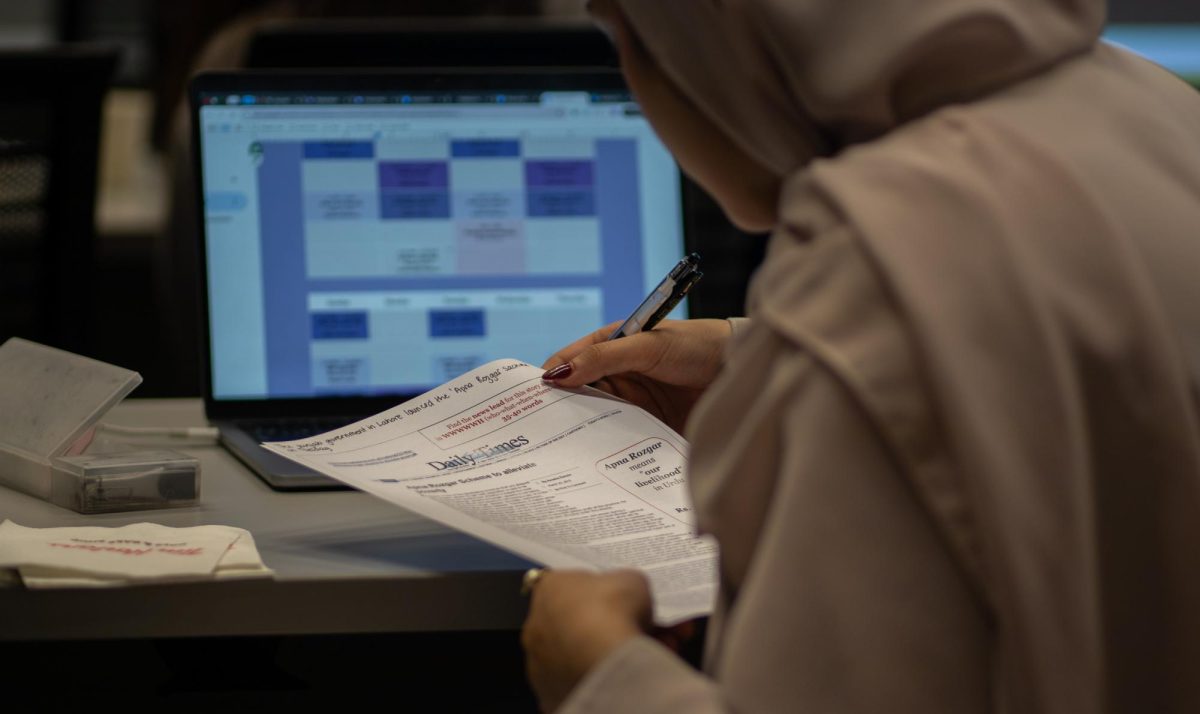
With the Spring 2026 course registration deadline fast approaching, it’s important for students to understand that cross-registration for language courses involves more than just seeking confirmation and paperwork; it requires planning ahead. Students face logistical hurdles – syncing class times, handling separate transcript processes, and ensuring credits transfer correctly, although grades don’t count towards the home GPA. Linguistically, Arabic’s pronunciation, Spanish’s grammatical structures, and French’s verb conjugations challenge even experienced learners. Motivations fluctuate, but exposure to a classroom’s diverse range of academic backgrounds is cited as a key driver.
The combination of structured environments, high expectations, and diverse educational cultures makes Education City’s language learning ecosystem both demanding and transformative. The payoff isn’t just measured in fluency. It’s found in newfound confidence, practical skills, and the ability to imagine careers and communities beyond the media classroom.