
From a futuristic idea to an everyday presence, the rise of artificial intelligence (AI) has compelled the education sector to rethink, refine and reshape the learning experience.
Scholars in fields driven by imagination and critical thinking, such as media and liberal arts education, have turned speculation into experimentation by exploring the ways in which AI could be integrated into learning experiences without losing the human touch.
As Qatar’s only media-focused institution for undergraduate students, Northwestern University in Qatar (NU-Q) holds a unique position wherein technology, storytelling and innovation are intertwined. It thus functions as a key site for understanding how human creativity and technological advancement can coexist in education.
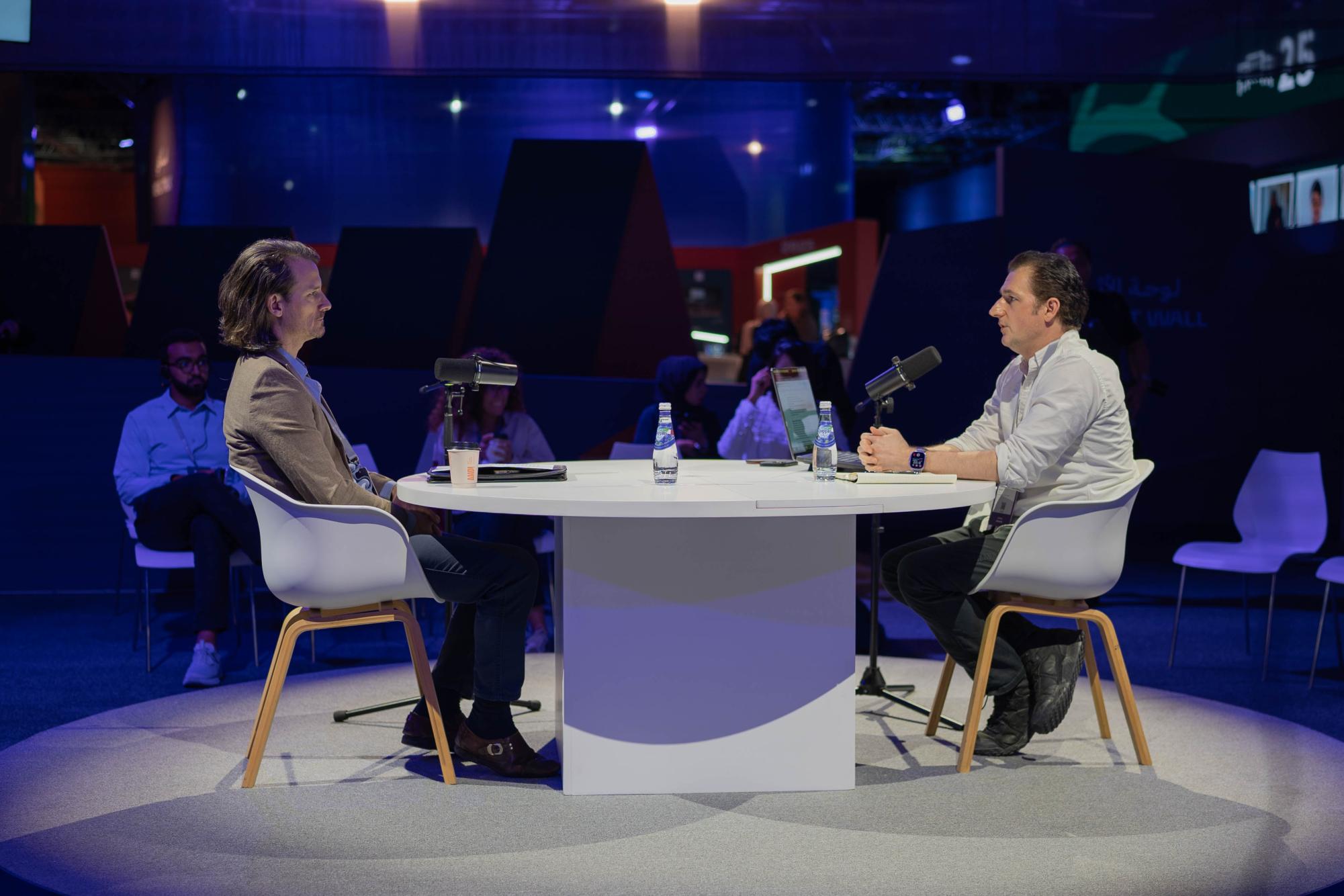
Building upon this role, NU-Q faculty members collaborated on the “WISE on Air” podcast during the 12th edition of the World Innovation Summit for Education (WISE), where Sam Meekings, associate professor in residence in the Liberal Arts program, served as the host, and Spencer Striker, a professor in residence in the Communication program, appeared as the guest interviewee to discuss the impact of AI in media and liberal arts education. Following this edition’s theme of “Humanity.io: Human Values at the Heart of Education,” their conversation addressed the tension between AI’s capacity to offer powerful tools that enhance learning and the challenges educators face to ensure students retain ownership, critical thinking, and the creative journey at the heart of their education.
For its duration of 30 minutes, the conversation highlighted the growing importance of structuring classes that prioritize students’ critical thinking skills as AI becomes part of the learning environment.
“LLMs have created a sort of cheat code that divorces students from the cognitive journey and a meaningful output of what they’ve learnt along the way,” Striker said.
Considering his work combines technological innovation with scholarly education, Striker encouraged students in his digital media design courses to use these tools in ways that strengthen—but do not replace—their own thinking.
“There’s a distance from the output because you have not put enough mental horsepower and energy into creating it,” Striker said, warning students about the loss of ownership that they may face with their work when it is largely made with AI.
He emphasized the need for teachers to return to implementing competence-based assessments in their classrooms, using his 2D Computer Animation course as an example. In that class, he instructs students to use AI tools that are complex and demand creative and critical thinking.
Meekings, however, had a different view of AI’s integration into liberal arts education. An expert in creative writing, he can easily spot when a student uses Gen-AI to craft their work. “It is relatively easy with a bit of practice to generate a 1000-word essay,” he admitted, but then argued the need to be intentional with what’s being created using these tools.

“You need to have a sense as an individual of what you want to express,” he said. “If the product is easier to create with a short set of prompts, where’s the learning process? Where’s the journey?”
While their views diverged in some areas, both professors acknowledged AI’s role in the great upscaling of knowledge, but rejected the idea of convenience replacing creativity.
“We need to center this concept of identity formation and get away from the idea of wanting to get an A and getting a degree,” Striker said, pointing out how the traditional system of education fails when students lose sight of the true goal: learning.
“Somewhere down the line, there’s going to be a lot of pain, but it’s going to be useful,” Meekings said, talking about the challenges of doing hard work without the use of AI, as well as the cognitive benefits that ultimately come out of it.
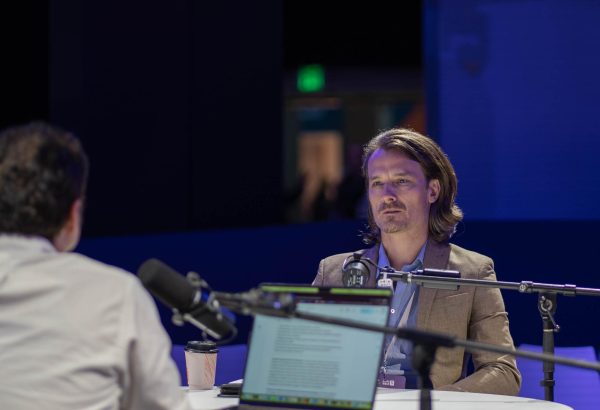
As educators, Meekings and Striker emphasized how teaching should be a balance between acquiring cognitive skills and having the ability to integrate AI tools systematically. They encouraged students to take advantage of all the possible methods of learning and knowledge by becoming active participants in their learning process instead of passive users of the latest AI technology.
“This is the most exciting time to be doing creative production,” Striker said. “At the same time, the breakneck pace of change is deeply unsettling.”
While educators debate AI’s role in academia, students are figuring out how to navigate the new challenges that the adoption of these tools has brought into their day-to-day coursework.
Yaqi Huang, a communication sophomore at NU-Q, has seen firsthand how AI is redefining the content and approach of her media classes. “Initially, my attitude towards Gen-AI was completely negative,” she said. “I feel like it’s just stealing the jobs of artists, writers, and creators.”
As she works toward her Film and Design minor, where a small number of courses now experiment with AI, she said the challenge now is learning how to use it responsibly. “Since we cannot stop the use of AI, we have to keep in mind how we are using it,” she said. “It’s a good tool for us to make and visualize our ideas, but definitely not in the production stage.”
Alexander Binay, a communication junior at NU-Q and a freelance photographer, also viewed AI negatively at first, perceiving the use of these tools to be “a lazy way of creating.”
But after taking Striker’s 3D Computer Animation class and being introduced to many advanced AI platforms, he realized how the technology would only perform well under original, creative and specific prompts.
“At the end of the day, it’s me who will determine the quality of the end product,” Binay said. “It’s really just a tool, and you have to realize that and always be self-conscious when using AI.”
For Hyemin Cho, a communication junior at NU-Q pursuing an AI and Media minor, she feels grateful to be in the middle of this technological transition. “The more I know, the better I can write prompts that actually guide AI into meaningful action,” she said.
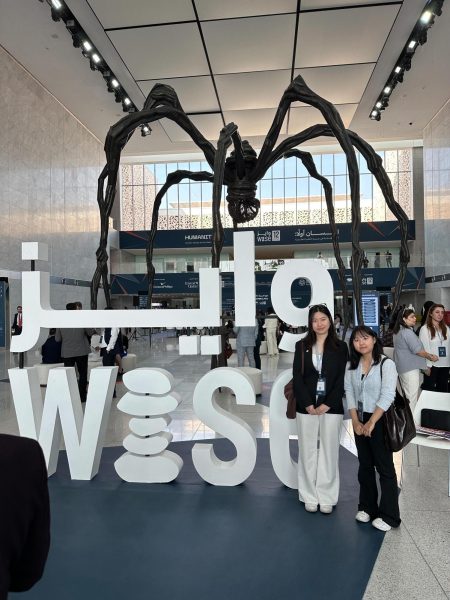
Reflecting on her academic journey as a search for her own identity, she reminds herself about the importance of using AI in a critical and flexible manner. “I made a promise to myself not to use it to generate full texts from scratch,” Cho said. “I try to use AI as a tool, not as an answer-maker.”
From professors to students, a mix of curiosity and caution molds new approaches to education as AI becomes increasingly embedded into the media and liberal arts field. At NU-Q, students are now adapting to the critical use of Gen-AI while understanding the potential consequences of its misuse to cognitive thinking and development. As AI propels itself forward, the real measure of students’ success will rely on their capability to leverage these tools for nurturing creativity, rather than hindering it.