

Artificial intelligence (AI) can generate a ninth-century Baghdad streetscape in seconds. It can render dozens of variations of House of Wisdom’s sandstone courtyards and Islamic Golden Age scholars. What it cannot do is decide which options belong in the story at all.
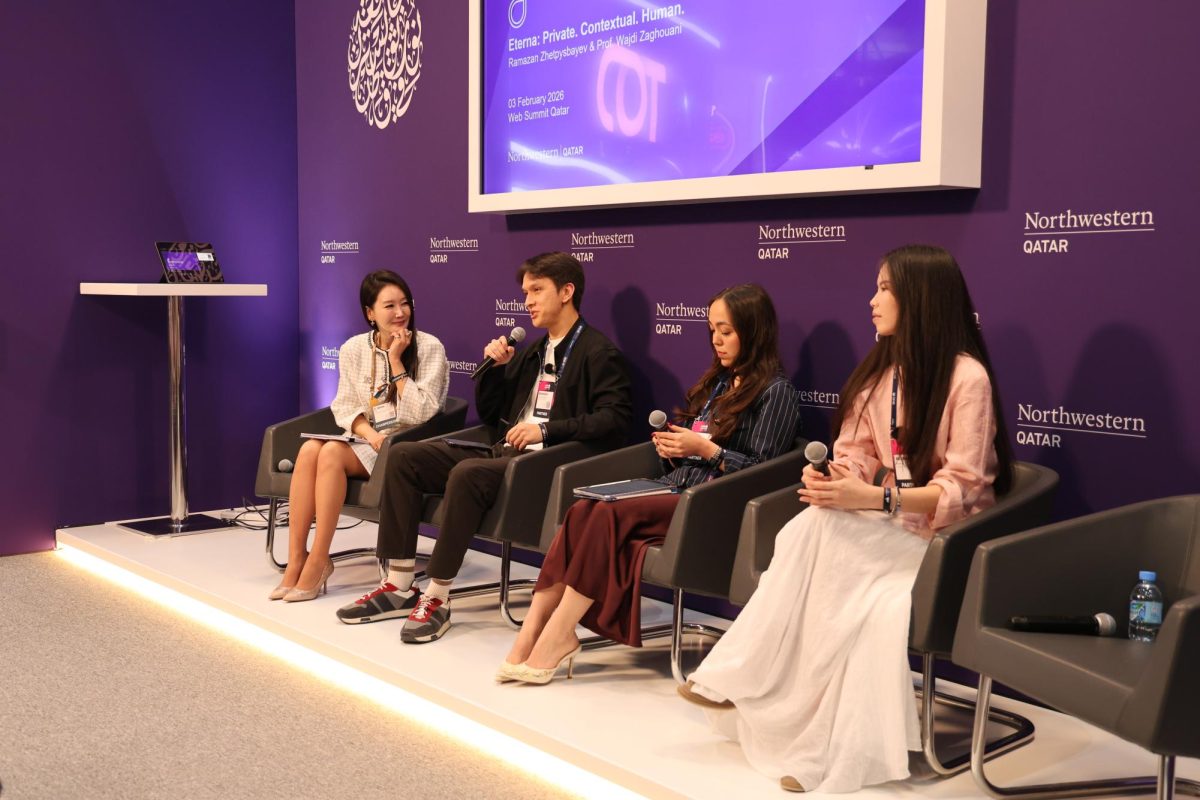
At Web Summit Qatar 2026, Spencer Striker, a professor of digital media in residence at Northwestern University in Qatar (NU-Q), took the audience through the process of building historical documentaries using AI. In a similar vein, Malika Assanseitova, a senior communication student and a recipient of the Artificial Intelligence and Media Lab (AIM-Lab)’s Advanced Undergraduate Research on Robots and AI (AURORA) grant, presented her research on adaptive storytelling systems that use AI to generate narrative variations in real time. Together, they explored the role of taste in AI-assisted storytelling and the technological boom that has made human curation more essential.
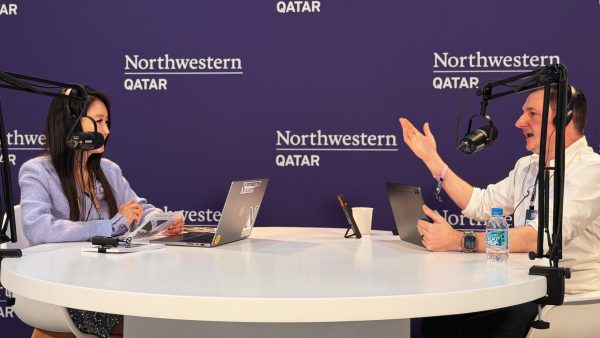
“We still have to choose the story,” Striker said in his podcast session with S. Venus Jin, associate dean of education at NU-Q, referring to decisions about narrative arc, location design, and character development. The technology this way generates dozens of options for any given scene, and humans must evaluate each one. “You have to go through each one. You’re constantly comparing.”
That comparative process constitutes the new creative labor in AI-augmented production. While machines can produce material and footage in short order, the storytellers are the ones who possess the aesthetic discernment to select what serves the narrative, as Striker did in his docudrama.
Striker’s AI tools can recreate ninth-century Baghdad with convincing detail. The House of Wisdom appears onscreen with accurate architecture and lighting. Muhammad ibn Musa al-Khwarizmi’s approach to solving mathematical equations gave the world both the word “algorithm” and the foundations of algebra. Striker can now generate that scholar’s world in minutes.
However, the technology fails at smaller details that need consistency throughout the story for emotional credibility. “The pauses are wrong, the micro expressions are wrong, the voice is not kind of right,” Striker said in his podcast session with S. Venus Jin, associate dean of education at NU-Q. Dramatic scenes require human performance, which AI may only approximate.
Can AI make curatorial choices that require creativity and emotions?
“No, it’s good at being an assistant,” Striker said. “Generative AI is a massive creative unlock,” he added, referring to the technology’s capacity to accelerate certain pre-production tasks. Still, he emphasized how the tool requires constant human oversight.
Assanseitova’s AURORA Grant project examines this topic from another angle. Her research, “From Prompt to Play,” explores how AI can generate branching narratives in interactive games.
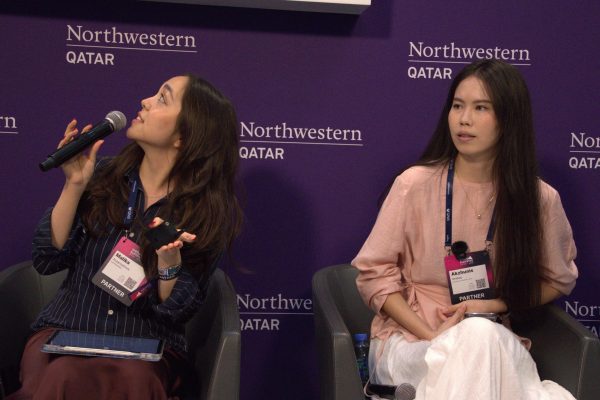
“AI succeeds in variations it can produce,” Assanseitova said. “There’s so many variations, so many styles, and can produce very fast and very cheap.” The technology reduces the cost of creating different narratives that usually require writing professionals and expensive production.
However, as we already know, AI is not perfect yet. “AI also fails in consistency, in the plot, in the story,” she said. “You have to make several attempts to get what you want.”
Ainur Yekpin, a second-year communication student who took Striker’s 2D Computer Animation class, experienced this limitation firsthand. In class, Striker showed students his work made with AI tools like NanoBanana or Midjourney.
“AI won’t always give you or create exactly what you want,” Yekpin said. “It doesn’t understand what you want; you need to paraphrase your words or try many times. Sometimes it will require a lot of time so AI will understand or at least get what you’re trying to say.”
The trial-and-error process Yekpin described mirrors what both Striker and Assanseitova emphasized in their presentations. AI generates options quickly, but getting the right option requires repeated attempts and constant adjustment.
Both Striker and Assanseitova focus on narrative craft in digital environments. Their presentations suggested that as AI tools become more sophisticated, the storytellers will need to master the art of curation alongside the technical skills. Taste comes from knowing what to keep, what to discard, and what serves the narrative.