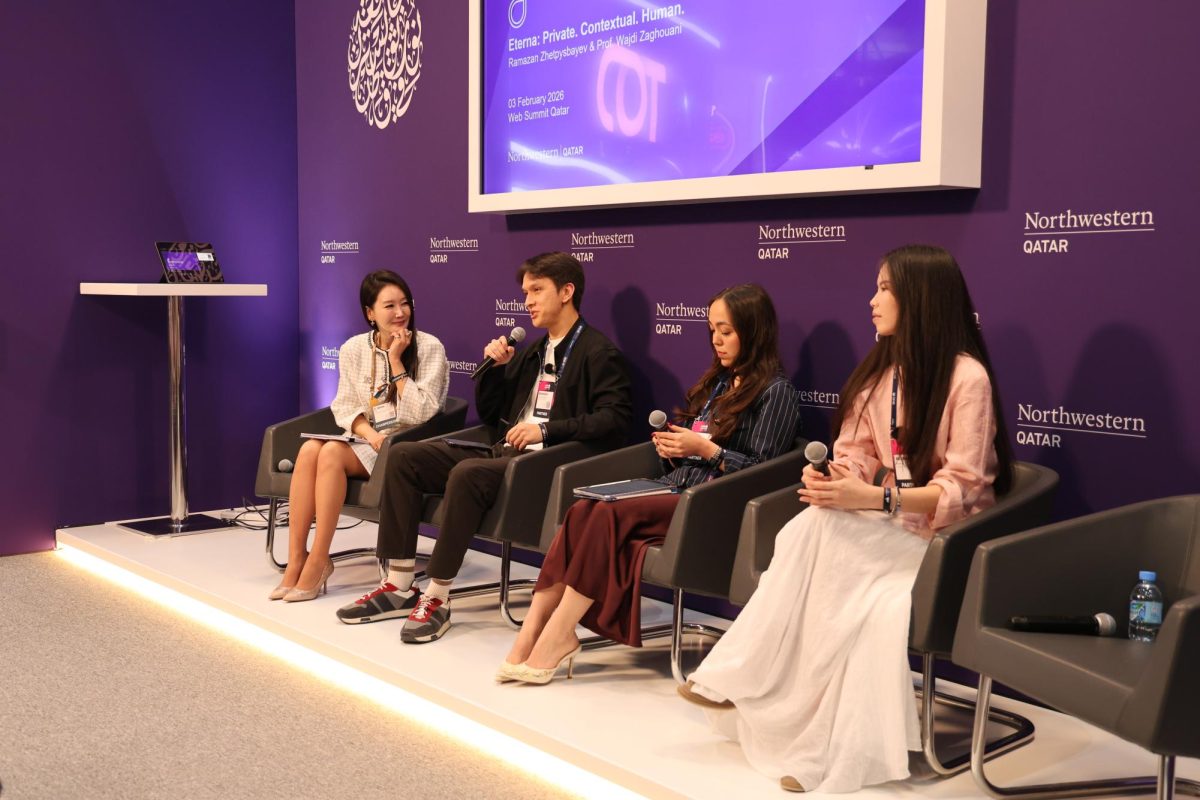


The 2026 edition of Web Summit Qatar attracted more than 30,000 attendees from around the globe. I’m proud to have been one of them. Thanks to a partner pass from Northwestern University in Qatar, I roamed the massive space for hours, engaging with the event primarily as an observer and not as an NU-Q Views reporter. I was interested in examining how emerging technologies shaped the environment and mediated human interactions.
The first thing I noticed wasn’t the hum of the crowd, but the strange realization that the room was intelligently looking back at me. Walking into Web Summit Qatar 2026 for the first time, I felt less like I was entering a conference and more like I was stepping into a living landscape. I was no longer just an observer—I was part of the data being read, tracked, and interpreted.
To my left, robots from Dukhan Bank shadowed my movements with an uncanny mimicry, matching my pace as I moved through the hall. Behind me, cameras concealed within decorative greenery, acting as surveillance devices, quietly gauged the flow of the crowd. It was a disorienting introduction to a new reality: Artificial Intelligence (AI) had finally jumped off our screens and into our physical surroundings. It was no longer a tool I could turn on and off at will, but a permanent feature of the world I was navigating.
On the exhibition floor, the focus was entirely on how this technology could be sold and used in our daily lives. At the Google Cloud booth, I participated in a demonstration where Gemini, Google’s new generative AI system, captured my portrait and instantly regenerated my likeness onto a different body for a physical print.
The demonstration was framed as playful and innovative, inviting participants to explore AI through creativity rather than caution. It was clear that accessibility was the goal, making complex systems feel intuitive, fast, and entertaining to the everyday user.
Watching my own face reconstructed in seconds was a surreal experience of how quickly these tools can alter reality. Yet, as I held the print in my hand, I found myself questioning how this technology shifts from a casual curiosity into the rigid structures of a professional organization.

This move toward a hands-free, seamless lifestyle continued at the Meta and Snapchat booths. Testing Ray-Ban’s Meta smart glasses, I realized how effortless the act of documentation has become. A simple “Hey Meta, take a photo” was all it took to capture a moment without even slowing down.
The ease of this interaction blurred the line between living a moment and recording it. Documentation no longer required intention. It happened automatically, raising questions about authorship, consent, and awareness in a world where everything can be captured instantly.
Snapchat showed a similar vision with their AR Spectacles, allowing me to interact with digital graphics layered over the real world in real-time. It felt highly convenient, where information is gathered without a single click, but it also sparked a lingering question about the cost of that ease.
The atmosphere of the Summit took a more serious, grounded turn during a masterclass with the Al Jazeera Media Network. Sitting in on the session with Mohammed El-Haddad, their Data Journalism Editor, and Suheyb Gazioglu from their AI Department, the conversation shifted from the wonder of convenience to the necessity of institutional safety.
Unlike the exhibition floor, this discussion emphasized restraint rather than expansion. The focus was no longer on what AI can do, but on what it should do—especially within a newsroom responsible for public trust and journalistic integrity.
For a professional news organization, AI is a powerful force that requires selective implementation. They emphasized that technology should only be utilized when necessary.
When I asked about the management of sensitive information in an automated environment, Gazioglu emphasized the importance of protective systems to ensure critical data remains isolated and secure.
“They have separate files for it; everything is kept confidential,” Gazioglu explained, referring to their use of data silos.
This practice ensures that private data is not fed into public AI models where it could be used to train global algorithms or risk exposure.
This approach stood in stark contrast to the open, consumer-driven AI showcased throughout the Summit. It reinforced the idea that while accessibility fuels innovation, boundaries are essential when accuracy, privacy, and ethics are at stake.
My time at the Summit made it clear that while AI can efficiently modify images or track movements, the underlying challenge is one of rigorous data management. The technology facilitates content generation, but the responsibility for protecting the security and accuracy of that information remains a human one.
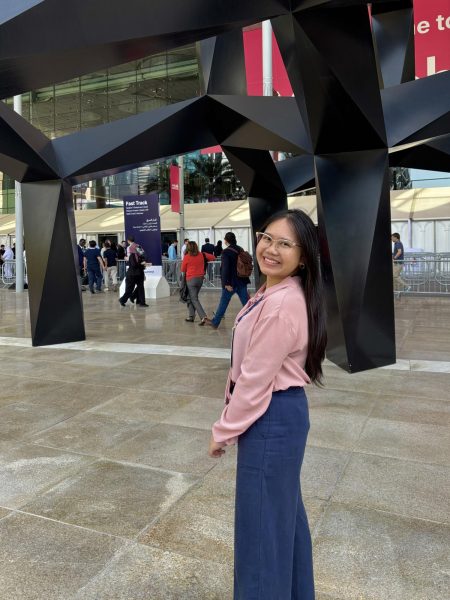
As a student journalist and a member of the NU-Q Views Social Media Team, witnessing these advancements provided a new perspective on the intersection of technology and storytelling. While my work usually focuses on the fast-paced world of digital engagement, the Summit reminded me that the writing, designing, and reporting side of our department carries a heavy responsibility. The Summit proved that while capturing content is now as easy as wearing a pair of glasses, the real work lies in the ethics behind the scenes.
We must now treat AI with a higher level of scrutiny. Moving forward, the challenge for any reporter is not just to post quickly, but to ensure that the tools we use to tell stories don’t end up overshadowing the truth of the stories themselves.