The music started softly, almost casually, as a small parcel made its way around a circle of elderly women seated in a tent beneath blue skies. When the music stopped, the woman holding it was asked to stand on one foot for 30 seconds. A teenage girl beside her counted aloud. They both began to wobble around the same time.
This was not the usual scene of Qatar National Sports Day.
Across the country, the annual holiday is usually marked by school competitions, company-sponsored races, and coordinated athletic events. But this year, a group of students from across Qatar Foundation (QF) schools—middle school through university—chose to spend the day differently. Organized under the student-led initiative Make A Change, they gathered at Al Bidda Park and partnered with elderly women from Ihsan, Qatar’s social care institution for senior citizens, to celebrate the day side by side.
Make A Change encourages youth to design and lead community-focused programs. The event reflected the group’s belief that meaningful impact begins with participation.
The morning began gently. Passing the parcel loosened the atmosphere, turning simple balance challenges into shared laughter. There was no separation between organizer and participant. The girls stood beside the women, counting, encouraging, and even wobbling in solidarity.
After a short break, the energy shifted from movement to memory. Students held up posters printed with common idioms, inviting the women to interpret their meanings. The responses came quickly, and sometimes competitively. In a few cases, the women corrected the students, drawing applause from the circle.
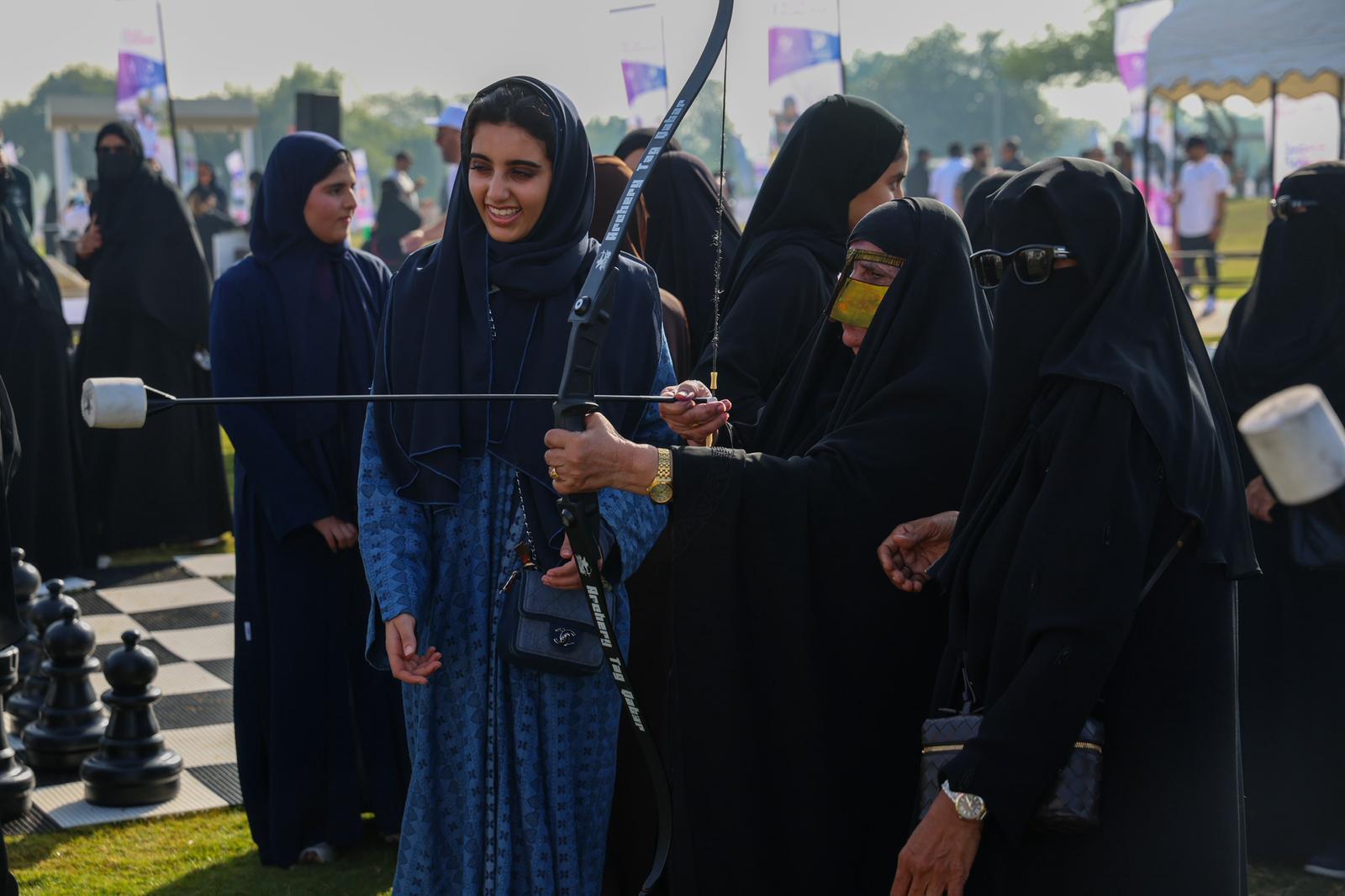
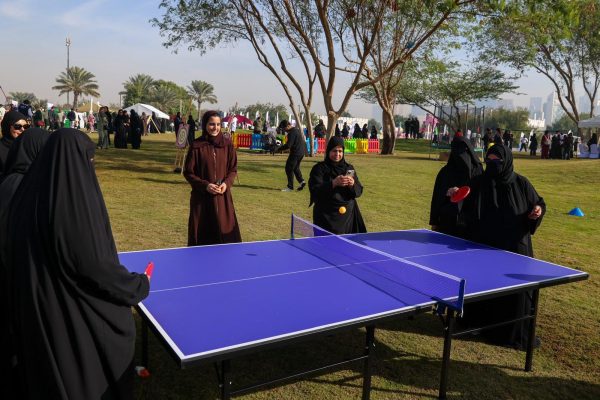
By the time they moved to archery, table tennis and blindfolded challenges, the pairings had already formed naturally. Some of the women had chosen their partners deliberately.
“She reminds me of my daughter,” said Jameela, a grandmother who had requested to stay paired with the same student throughout the morning. The resemblance was subtle—similar eyes, the same smile—but enough to matter.
Another participant, Om Hathir, described the feeling more simply. “When I look at them, I see my own girls. They are my own girls,” she said.
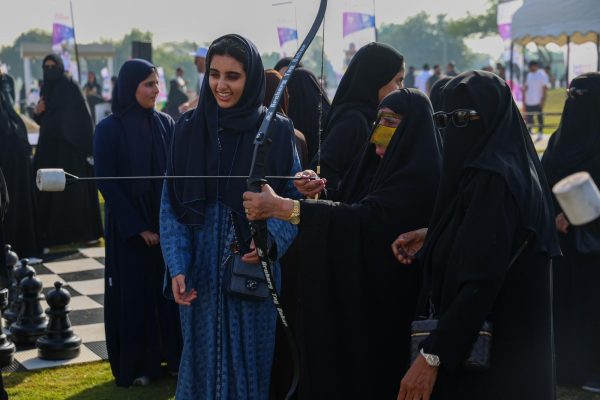
At the archery station, students helped retrieve arrows from the grass and adjusted grips when needed. At the table tennis tables, pairs competed together against other pairs. During blindfolded games, one partner closed her eyes while the other guided her with steady instructions. Balls arced toward baskets; missed shots were followed by immediate retries.
What stood out was not the difficulty of the games, but the consistency of the partnerships. No one rotated away without checking in with her counterpart. A few women refused to switch stations unless their chosen student came with them.
As the morning progressed, the structure loosened. The games became secondary to conversation. Students and elderly women remained together, no longer moving because of a whistle or instruction but because they wanted to continue.
When the students began preparing to leave, several of the women asked if they would return.
“They will come again?” one asked quietly.
The day closed with group stretches focused on mobility. Younger students stood in the same rows as the women, mirroring their movements rather than leading them.
From a distance, Sports Day at Al Bidda Park may not have appeared dramatically different from other gatherings across Doha. There were no grand stages or public ceremonies. But within the circle that formed that morning, the holiday took on a different meaning; not as a display of performance, but as a deliberate act of closeness.
For a few hours, daughters were found in unfamiliar faces. And when the girls left, they were missed.