It was sometime after midnight when one of our interviewees said it.
We had been speaking to people in Qatar about ride-hailing habits: why they choose certain platforms, what makes them trust a driver, and what matters beyond price.
Most answers sounded practical at first. Safety. Timing. Convenience.
Then, in the middle of the conversation, someone paused and said:
“I keep checking my phone until she gets home.”
The room went quiet for a second.
There was no need to ask who “she” was. Everyone understood immediately.
A daughter. A sister. A friend. Someone they cared about.
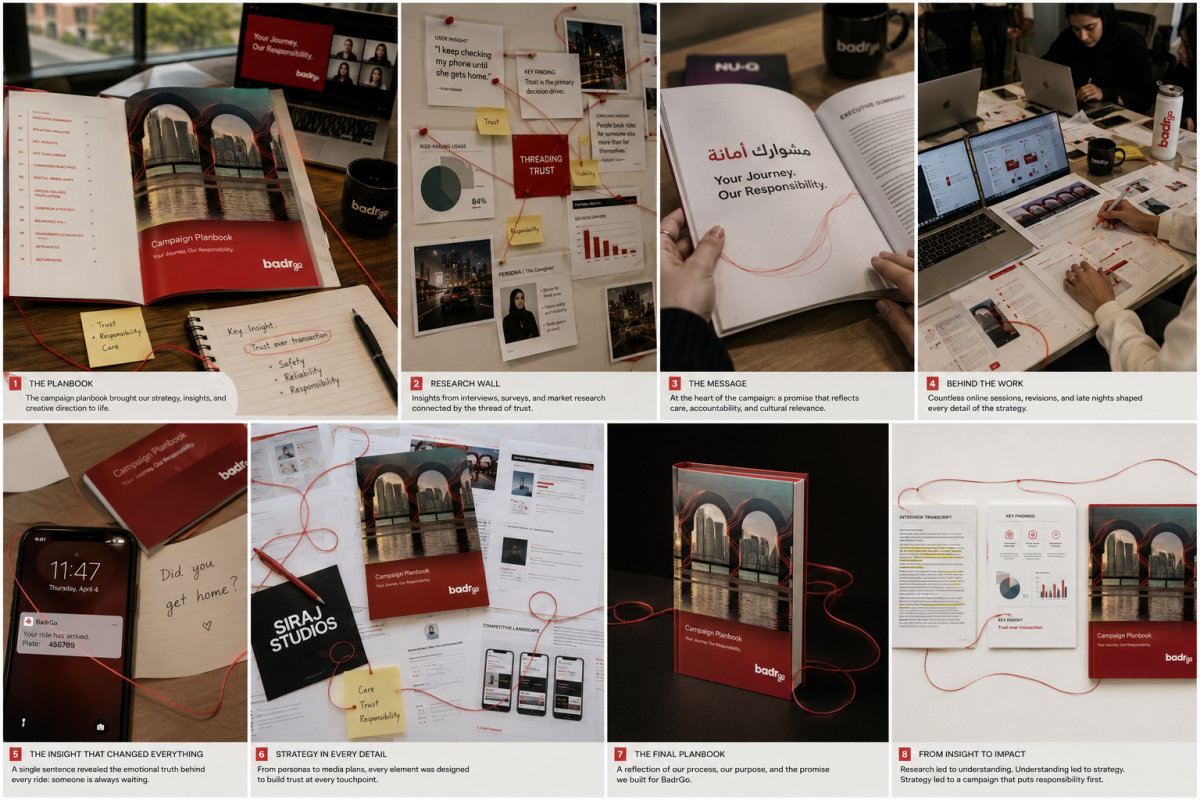
That single sentence changed the direction of our entire campaign.
When our capstone for the Strategic Communication minor at Northwestern University in Qatar first began, we thought we were building a campaign about mobility. A ride-hailing platform. User behavior. Market competition. The kind of project that starts with research decks and ends with a final presentation.
But somewhere between the interviews, workshops, revisions, and long nights online, the project became about something much more human.
Responsibility.
Our student agency, Siraj Studios, was assigned BadrGo as our client. The team included Sabeeka Al-Kuwari (Communication ’27), Nouf Al-Nassiri (Communication ’27), Maryam Al-Kubaisi (Communication ’26), Lolwa Al-Misned (Communication ’26), Lama Al-Khater (Communication ’26), Aldana Al-Maslamani (Communication ’27), and Hamda Al-Kuwari (Communication ’27).
At first, we approached the brand the way communication students are trained to: category research, audience segmentation, competitor analysis, and positioning. Structured. Methodical. Predictable.
Our instructor, Professor in Residence Mohammed Ibahrine, challenged that thinking almost immediately.
“There is no effective communication strategy without data,” he reminded us constantly.
At first, we treated that like a strategic principle. Eventually, we understood it differently. Data was not just numbers or graphs. It was people. Conversations. Habits. Emotions hidden inside ordinary routines.
The deeper we went into research, the more one pattern kept appearing: in Qatar, ride-hailing is often not about the person taking the ride. It is about the person booking it for someone else.
Parents tracking their children’s journeys home. Friends checking in after late nights. Families sending rides for relatives. The act of booking a car carried emotional weight that extended beyond transportation itself.
People were not simply purchasing convenience.
They were managing care.
That realization slowed our process down in the best possible way. Instead of rushing toward a slogan or visual identity, we spent more time listening. AI-assisted workshops using Gemini introduced us to the idea of strategic flow: allowing insights to emerge gradually instead of forcing ideas too quickly. The process became less about finding a clever campaign and more about recognizing something that already existed in people’s lives.
Then, the line appeared:
مشوارك أمانة
Your Journey. Our Responsibility.
It did not feel invented. It felt familiar, like something that had already been there waiting for us to notice it.
Soon after, the image of the thread emerged.
A red thread connecting moments of care across the city. Sometimes visible, sometimes subtle. A mother waiting at home. A “Did you get home?” message. A quiet check-in after midnight. The thread became a way to visualize the emotional connections hidden behind everyday movement.
Not every campaign insight arrives dramatically. This one settled slowly, then all at once.
Building the campaign itself was a constant process of revision. Ideas were tested, removed, rebuilt, and questioned again. Because much of the work happened online, every presentation forced us to communicate clearly through the work itself. There was no relying on performance or energy in the room. Every slide had to justify its existence.
Over time, the project became sharper. More intentional.
What surprised us most was how quickly the boundary between classroom learning and professional reality began to disappear.
After our final presentation, BadrGo moved forward with integrating Claude AI into parts of its system, influenced by how our team approached AI-assisted strategy throughout the project.
For a moment, we stopped feeling like students presenting ideas and started feeling like strategists building something real.
When Siraj Studios was announced as the first-place team, the recognition mattered, but not as much as the process that led to it. The interviews. The uncertainty. The revisions. The moments where we had to stop and completely rethink what we thought the campaign was about.
What began as a university capstone has continued beyond the classroom. Our team will continue working with BadrGo, developing ideas that started as student research into applied strategic communication work.
As a team, we are especially grateful to Professor Ibahrine, whose mentorship shaped every stage of this project. His insistence on grounding creativity in research challenged us to think more deeply, listen more carefully, and approach communication with both rigor and empathy.
From the outside, the project may look like a campaign about ride-hailing.
But beneath it was something else entirely.
Not speed.
Not convenience.
Responsibility.
Because somewhere between the person who books the ride and the person who takes it, there is always someone waiting for the notification that says they made it home safely.
That is where the thread begins.